Published January 19, 2026
Canada’s housing system is facing a critical inflection point as the effects of declining homeownership prospects ripple through the entire market and further threaten the country’s long-term housing supply. Coupled with this, in key regions like Ontario and B.C., layoffs from the significant slowdown are creating a permanent loss of home building capacity where we need more housing the most. Action is needed now to expand GST relief to all buyers and to new housing units created through renovation. (We also need a rapid passing of Bill C-4 as the Senate returns, and then Royal Assent, so that the GST relief on new homes for first-time buyers that was promised back in March can actually come into effect and stop hindering the market). Lowering taxes will help address affordability challenges and get the market moving again so that builders can keep building much-needed housing supply.
CHBA Recommendations
If the federal government truly wants to support housing affordability, it should:
- Broaden the GST relief to all buyers of new construction homes.
- Make the GST relief applicable to renovations that add an additional unit of housing to existing homes, like Accessory Dwelling Units (ADUs) and secondary suites.
GST relief is needed for all buyers, not just for first-time buyers
Supporting first-time buyers in their efforts to get into the housing market is extremely important, and the long-awaited GST relief is a good initial policy move to do so. But according to the Parliamentary Budget Officer, first-time buyers make up only 5.8% of buyers of new homes, which means that 94% of potential for new construction will not see any relief from GST. To support homeownership and the doubling of housing starts, the relief needs to be extended to all buyers.
Expanding the rebate would encourage more “move-up” housing by helping families move from starter homes into larger homes, which frees up starter homes for others. It would also help older adults downsize into newly-built homes that better suit their needs, creating more supply and releasing family-sized homes back into the market.
GST relief should also be extended to the creation of accessory dwelling units (ADUs) and renovations that create secondary suites to create more infill housing supply. These housing types have the added benefit of supporting seniors looking to age in place, students, lower income workers, and many others that can benefit from these new housing options.
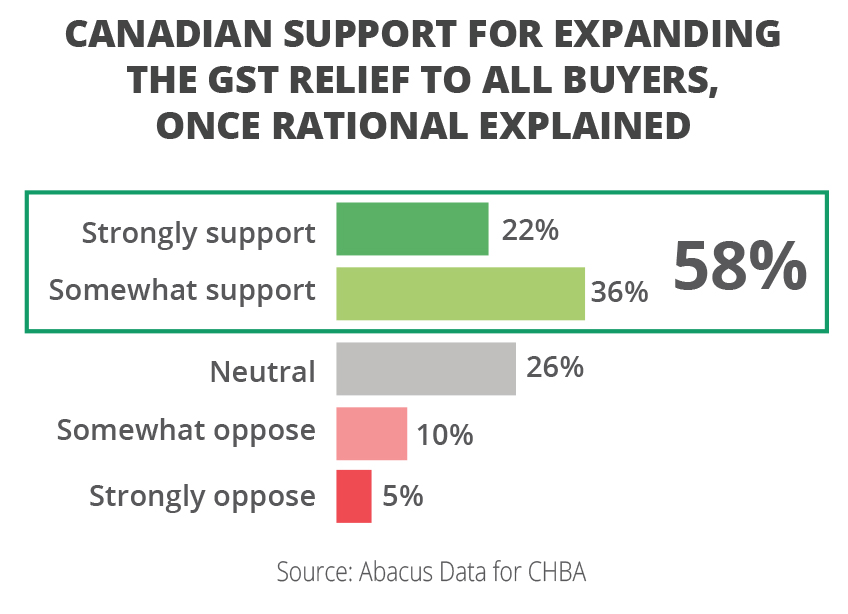
A public opinion poll done by Abacus Data for CHBA showed that once the rational is explained to them, 58% of Canadians support expanding the GST relief to all buyers. Only 15% oppose.
Declining homeownership rates are a systemic failure for housing supply
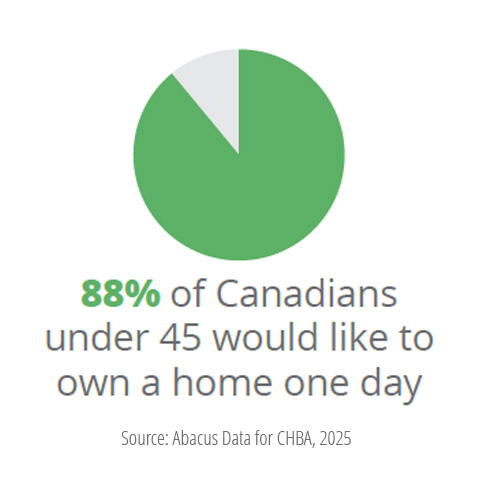
Middle-class Canadians with good jobs and strong incomes still deserve the chance to buy a home, and 88% of Canadians under 45 would like to own a home one day. But high taxation and systemic barriers are resulting in declining homeownership rates, widening economic divides, and fewer homes being built for ownership.
Without actions to expand GST relief to all new homes to turn the tide, along with other measures, falling homeownership rates will continue to have a profound impact on the Canadian economy, leading to less equity and housing security for Canadians, job loss and the further deterioration of affordability.
Consequences of declining homeownership on housing supply
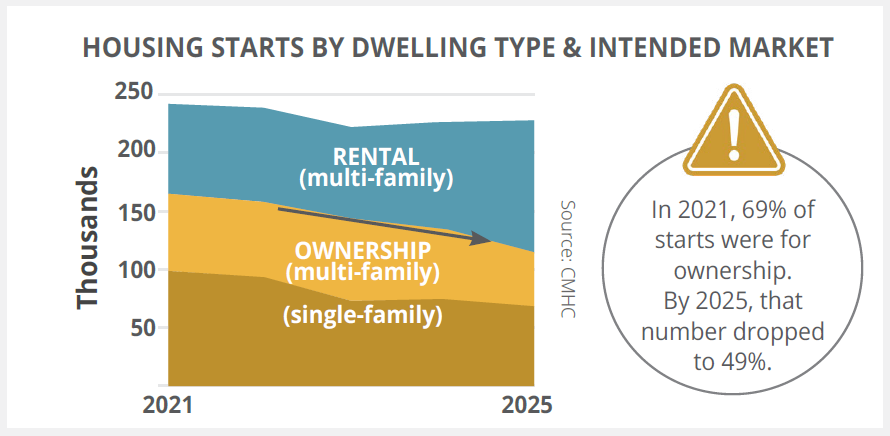
Despite the federal government’s stated goal to double housing starts, new housing starts for ownership have fallen from 69% in 2021 to 49% today, with 10,000 fewer starts for ownership this year compared to last. This reflects a systemic slide towards making Canada a nation of renters, which impacts the entire housing continuum. Canada will not be able to double housing starts if individual families cannot invest to buy their own homes.
Canada’s home construction crisis at a glance
The home construction sector is in dire shape, particularly in Ontario and British Columbia – the two provinces that CHMC statistics show need the greatest number of new homes.
CHBA’s Housing Market Index (HMI) shows that home builder sentiment for homes for ownership is at record lows. The multi-family HMI in Ontario was an abysmal 2.5 (out of 100) in the fourth quarter of 2025, and the single-family HMI was 10.4. The HMI points directly to significantly fewer housing starts for ownership ahead.
According to the Q3 2025 HMI, 86% of builders nationally are concerned about the well-being of their businesses over the next 12 months, and that jumps to 91% in Ontario, where 44% are very concerned.
In Q4, the HMI shows that 38% of builders had to lay off workers, with no plans to rehire – up considerably from 27% this time last year (this is at 53% for Ontario builders). Builders are reticent to lay off workers because they may never come back—these layoffs are leading to permanent loss of industry capacity.
Without substantial policy change like GST relief, the HMI results indicate that these employment declines will accelerate.
Meanwhile, the government is not placing the same urgency on expanding the GST relief on new housing and helping to address out of control development charges as it is on other measures like government-supported social housing and purpose-built rental housing. Those important, but insufficient without policy to help middle-class Canadians in terms of homeownership. Until the government prioritizes homeownership as well, the housing crisis will only get worse. The sector will see mass layoffs across the country – which is already happening in Ontario and B.C, and a widening housing supply shortage.
Read more of CHBA’s recommendations to help address Canada’s housing challenges here.